Showing posts with label lessons. Show all posts

Friday, May 23, 2014

Different? Really?

source

Today, I’ve been pondering something. Are we really all as different as we’d like to think?

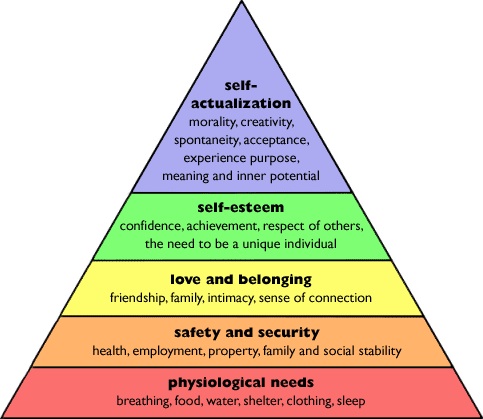
As a psychology major, I understand that we all thrive off of certain basic needs, often derived from Maslow’s hierarchy of needs (shown above). The degree to which we need those things may vary, but basic needs are the same.

There have been events taking place in the area of the state where I went to college that are despicable, and I’m not certain that so many people are as different as we may think. Everyone loves, everyone thrives,  everyone struggles, and everyone fails. Is it really all that necessary to understand the intricacies of what that means for an individual so much so that it robs someone of his or her livelihood?

Love is love. Community is community. So are we all that different, really?

Oh wait. I type with one hand, so maybe this blog post shouldn’t be published. After all, it wasn’t typed with the standard two-handed conventions.

Wednesday, May 21, 2014

Strappy Sandals

source
Most of the time, I’m fortunate enough to be able to view my challenges in a rather positive light. When it comes to anything shoe-related, that’s a different story.

One of the reasons for that is that I wear orthotics on my feet that have the purpose of supporting my ankles in favor of balance when standing and walking. Because they’re so bulky, I am unable to wear the cute strappy sandals that are so common in the South for summer.

Take today, for example. The outfit that I’ll be wearing out to coffee with a friend is perfect for a cute pair of strappy sandals. Instead, I’ll wear Keds sneakers. While it doesn’t sound bad, try putting your foot in a sock and then covering it in thick plastic in mid-May in Georgia.

I think about this all the time, especially since I went to college in a town where it was exceptionally warm for nearly half the year, but I guess if that’s the most I’m concerned with most of the time, I’m pretty fortunate.

Next time you wear strappy sandals, be grateful for the little things (and think of me, of course!)

Monday, May 19, 2014

Just Living Life


One of the most difficult things that those of us with disabilities face in most any situation is the fact that the media often portrays any sort of challenge as “heroic”.  The term used by many individuals with disabilities is “inspiro-porn” meaning that stories and other portrayals are usually framed with the notion that people with disabilities and the stories involving us are newsworthy, they’re “magical”, or something similar. 

Luckily, I grew up with a twin sister who isn’t directly affected by any sort of challenge, so my disability was never shed in the “inspirational” light. 

I’ll never understand why this story highlights the fact that this young man is now in a wheelchair to emphasize that he finished college. Finishing college is a wonderful milestone for anyone, regardless of their preferred method of mobility. Or why the fact that this senior in high school went to prom with a “crush, close friend” ends up on a CBS website. It’s 2014; if these stories are truly newsworthy, why are my parents, very normal, average, middle class folks, not being chased by the paparazzi as they travel to work each day? These people are normal people doing everyday things like going to prom and going to college, so why isn’t every person who goes to college or who goes to prom with a close friend interviewed by a national news outlet?

Take me, for example. I’m certainly excited, honored, and thrilled to be attending a nationally ranked university for graduate school. My program is even #17 in the nation. Does my excitement have anything to do with the fact that I’m going to be a graduate student with a disability living in Lexington, Kentucky and attending the University of Kentucky? I honestly haven’t even thought about it in that vein. I’m going to further my education, just like anyone, with or without a disability, would have the opportunity to do. Is the fact that I’m moving 400 miles from anything familiar a feat because I have a disability? No, it’s a feat because I haven’t known anything else in my nearly 24 years, save the fact that I went to college in a small, rural town about two hours away for four and a half years. I won’t lie and say that I haven’t found extreme comfort in the fact that there are over 1,000 students with disabilities at the University of Kentucky. I can say one thing for certain for each and every one of us: we aren’t attending school simply because we have disabilities. Iff anything, society would tell us, just as these “news stories” have implied, that it would be much easier for us to sit around and wait on the cameras. Instead, we choose to better ourselves, better our society, and better the futures of generations.

I don’t want media attention because I’m doing what people my age and in my stage of life are typically doing; I just want a smile. And I want people to recognize that it wasn’t any more difficult or easier for me to gain admission into my program. I want people to realize that the best recognition that they can give me is equality because, truthfully, I’m just living life.

Wednesday, April 30, 2014

The Teacher Who (Teaches) Me Everything


It was my freshman year of college, and it’s a pretty safe bet to say that I was excited but scared out of my mind. One of my first friends in college was a couple years older than me, and she was a music therapy major.  On Mondays, she led a music therapy session, and she offered for me to be a student assistant in the session. While I was looking for ways to become involved on campus, I was excited to be involved and serving adults with developmental disabilities in this way.  My friend was and is very gifted in her profession, and she was very well-liked among the faculty of the department. Our session met in a classroom that is used as a meeting space for classes, student groups, and many other endeavors. 

One day, about two months into my freshman year, one of the music therapy professors walked into the room to prepare for a class. My friend made small talk, and eventually came to introduce me to this amazing professor, pictured above at right.

After getting to know Dr. Keith over the next few months, attending a concert he conducted, and understanding that we had more in common than most people, I knew that it would be a friendship and a mentorship that would last forever. It was soon discovered that he had longtime connections with a family member, and I felt more comfortable around him than around most people at that stage in life. 

The first portion of my college experience wasn’t exactly sunshine and roses, and there were many rough patches that are difficult to re-tell, to this day.  One of the three or four things that remained constant, however, was Dr. Keith and his unwavering support. There were times where I would walk into his office, even unsure of what was coming out of my own mouth. Dr. Keith simply listened, and he began to teach me valuable lessons for which I’ll be forever grateful.  There was a time in which i had decided to declare a music therapy major, and after many, many sessions of tears and frustration over guitar playing with Dr. Keith, it was decided, and heartbreaking, that it just wasn’t feasible. 

Later that month, Dr. Keith taught me a skill that I’ve used every single day since: how to advocate and educate in front of a group of people. In one of the courses that he teaches, he explores different categories of impairment and various interventions that may be effective in the music therapy setting. Each year, from 2009-2013, I went and told my story to his students. Dr. Keith, in this small way, allowed me to see that my story was important to him and to others, and he gave me an avenue that was informative but familiar.  For the last several years, if you were a student in Dr. Keith’s Principles with Children course, bringing a clean sock to class wasn’t out of the ordinary. 

After a couple years, it came time for me to be able to take Dr. Keith’s courses as electives.  I was overjoyed to be sitting in one of my favorite courses, Psychology of Music, with the man who’d already taught me more than I can ever quantify. It was special. If I was having a bad day, I didn’t have to say anything  for him to know that something was just “off”. It was more important to me to attend his classes out of respect for his teaching and for his knowledge than I ever may be able to adequately express. We would engage in some of the most intellectually stimulating conversation to which I have ever been exposed, and Dr. Keith and I had a special connection.

I knew several things, from a personal perspective, that connected us both at the heart and at the head. I have, and will never have, a teacher who has taught me just as much a about life outside the classroom as the academic content inside the classroom, as Dr. Keith has.  We have shared many laughs, many tears, and many frustrations, and I will forever be grateful for his willingness and for his mentorship. Everyone should have a Doug Keith in their lives. 

When it came time for me to choose an escort for graduation, it was a no-brainer. Dr. Keith, the professor who has fostered my love for music therapy, my love for research, and my genuine love for people, was the perfect person, without a doubt. I’m so grateful to he and “his” Joe for what they mean to me and all that they’ve done.  The neat thing is that just because I’m moving to Kentucky doesn’t mean we’re not there for each other. That simple fact means more than I could quantify!

Thanks a million, Dr. Keith, and just in case you’re wondering, I ain’t lyin’!


Tuesday, April 29, 2014

People Are Like Plants

Bear with me for a few minutes here, folks. This is a stretch from graduate school or moving related subject matter, but in an email conversation with a mentor this week that was continued via text message,  I came to realize that people are like plants.

Before I totally lose you. think about it. When you were formed, you were but a tiny morsel, similar to the soil that provides the fertile ground on which you’ll grow and develop. Your root system, your heredity, determines your strength, and to a degree, it determines the way you’ll ultimately see the world and the way that you’ll grow and develop.

In a sense, I’m going through a period of realization in which I must remember my roots.  The flowering branches and the situational evidence for things that have happened in my life have simply colored my experience, all for the better, but remembering my roots is important in this period of stepping out into that field of unknown. When you hear of a plant being re-potted or simply relocated, it must have the exact same  conditions as before, but the fact that the plant is in a new place isn’t changing.

The fact that we need people, we need basic survival materials (food, shelter. clothing, water, etc.), and the fact that we need relationships with said people won’t change no matter where we are. Even though the honeybee sucks the pollen and nectar from the flower at the start, the process will make a beautiful flower, yet again, at the end.  Just as when I begin the great adventure to Kentucky, I’ll need the same things that I needed as a student in Georgia. They’ll be there; I just have to look in different places and become accustomed to the surroundings of Lexington, similar to he process for a plant that has been re-potted.

There’s been an intensely personal struggle with a relationship that everyone needs but that I don’t have for the last several years of my life, and I’ve been the plant with the motto to bloom where I’m planted because the adaptability of my root system speaks volumes. It’s not important to discuss this relationship dynamics, but I a honestly impressed with the resiliency of the human spirit to fill the void with thins that matter, things that can fill the spirit in equal or better ways.

Relocation requires resiliency, and deficit requires compensation, much like in the life cycle of a plant. Bloom where you’re planted,  and good things will blossom.

Wednesday, April 23, 2014

Why Rehabilitation Counseling? My Story

The number one question that I, or anyone who is entering a new phase of education, am asked is about my program of study. And since many are unsure of the field, I thought I’d take some time to delve into the purpose, the motives, and the duties. Equally important is my choice to enter the field, and there is certainly a story there.

When most people hear the words “rehabilitation” and “counseling”, they automatically think about substance abuse and the like. While we will work with clients who have substance abuse difficulties, we will examine and mitigate the effects of the abuse that may be disabling. In addition, it is nearly impossible for a counselor to serve a client who is an active drug user because of his or her inability to be employed.  For example, a client with many years of substance abuse may have memory recall complications. In that instance, depending on the specific circumstance, the client may find that it affects him or her in the workplace or otherwise. A rehabilitation counselor would work to find strategies to help the client to achieve the maximum level of independence and self-sufficiency possible in every aspect of life. For an adult, it may be focused in the workplace, but for a college student, the efforts would be toward success and mitigation of the effects on academic success.

Most often, according to CORE (Council on Rehabilitation Education), an accreditation organization for graduate programs, “[r]ehabilitation [c]ounseling emphasizes empowerment of individuals with disabilities to maximize employability, attain economic self-sufficiency, independence, inclusion, and integration into American society. The philosophical foundation of rehabilitation counseling includes the belief in advocacy and the rights of people with disabilities.  Rehabilitation counseling emphasizes integration and inclusion, focusing on assets of people, and assisting in the pursuit of independence. By moving from a status of dependence to a status of independence, personal adjustment and/or the opportunity to succeed economically, via employment, can be achieved.”

Yet, you still have that question. Why? How?

You see, it started when I was 15 years old. I spent the summer volunteering nearly 50 hours per week at a children’s respite center for children who were determined to be medically fragile.  Ironically enough, most of them shared a diagnostic label with me. And as a just-turned 15 year old, that was hard to see.  I didn’t know, at the time, how to articulate exactly what I was feeling, but I know now that I was grappling with the fact that I honestly didn’t think it was fair that people with the same diagnostic label could perform and such a wide range of levels. Why were these children confined to a wheelchair, but I was the one able to walk? I’d worked brief stints in a self-contained classroom, but giving parents a break seemed like more tangible, meaningful work at that point in my life.

As life progressed and I started having to make decisions, pray over my calling, and devote my life to a purpose, I discovered rehabilitation counseling through a mentor during my junior year of high school. He was the director of disability services during my first three years of college, and he’d gotten his degree at the age of 40 while working full time and raising two children through the online degree program at the University of Kentucky. He does his work with such passion and purpose, and honestly, it was and is infectious.

The fact that my whole career will be spent advocating for and ensuring that people with disabilities are gainfully employed and have means of self-sufficiency just warms my heart. That’s the way it should be. I can’t imagine a place where just because someone looks differently or acts differently, it may affect their chances to enter the workforce. If I put my left leg into my pants first instead of my right, does it mean that I left my house without wearing pants? No. It just means that I did it a bit differently.

Next time you see someone out working in a public place who may accomplish the work task in a non-traditional way, stop and think. Now, you’re also aware of those of us who ensure that everyone is created equal within the workplace.

I ask you: Why NOT rehabilitation counseling?

Friday, March 14, 2014

Where Does Motivation Come From?

During this stage of my life, I'm finding it challenging to retain the sources of motivation that come with going to school full-time and being surrounded by creative, intelligent people with every turn of my head. Fortunately, I'm returning there in August, albeit to a new university, a new setting, and new sights, smells, and sounds.

Most people are shocked when they discover that my motivation does not come from other people with disabilities. I often find solace in understanding that people with disabilities similar to my own have been on the adventure before me, but that's simply a "logistics" meter. Even in 2014, I still have concerns about the accessibility of modern public facilities, as well as the quality of service offered to those with disabilities.

In a recent conversation with a mentor who played football for a legendary coach in college, works for a university to which I have extreme loyalty, and who has a broadcasting background, he simply asked, "Where do you learn? Who motivates you? Is there anybody you study?" Very generally, I answered, "People without disabilities." The reasons for that are many, but the biggest part of my logic centers around the idea that people who are in similar situations are not motivations, simply due to the fact that they may not offer advice that will allow you to better your journey. For example, if two 23 year old young professionals attempted to mentor each other, it would turn into an accountability situation. Since  experience is one of the best teachers we have, the opportunity to learn from experience can come from mentorship.

I'm motivated by the fact that society sees disability as a negative concept. I'm motivated, not because I can prove people wrong with my actions, but because I've always thought of it as the best thing to ever happen to me. Since I've graduated college, the reaction to the simple fact that it happened has been astounding. Honestly, the actions and reactions of people toward me and toward my situation are my biggest source of motivation. Why should I only walk 5 steps when I can walk 10, get more exercise, and have legs like no one has ever seen?

Most recently, I'm motivated by college athletes. Why? College athletes who are successful and who flourish on and off the field of play understand the importance of living a full life, but also the importance of using the platform that a student-athlete offers to be leaders in the community and elsewhere. It doesn't take being a student-athlete to come to these realizations, but the lifestyle allows for an amazing opportunity to see, do, and be many things for the athlete and for others. Wants motivate people far too often, when needs should be driving the bus. A need to give back to the community is not something that is innate in many, but realizing the need can transform sources of motivation. It's an explanation for why my passion for community service is off the charts!

Motivation comes in all shapes and sizes that can vary depending on the current situation and circumstances. Knowing that, why has it become crucial that we fit into a mold that may not fit us? Why do I have to be motivated by people with disabilities just because I happen to have one?

Where does your motivation come from?


Thursday, January 23, 2014

Bullying: My Tips and Tricks

In recent weeks, I've noticed a surge in blog posts from concerned parents of young children (usually aged 10 and under) about their children becoming victims of bullying in school. As hard as it is to admit, the fact that I am a young adult with a disability inevitably means that I have ample experience with the big, usually burly, characters who bully. Because I never want my experiences to happen to anyone else, I thought I'd offer a few points. If you are enduring bullying, these tips will apply to you, and if you're a parent of a child who can't quite understand these situations from emotional angles, I hope this will prove helpful.

**As always, I'm never claiming any content to be professional advice. Rather, this advice is based solely on personal accounts and experiences. Should you have serious issues and troubles, I would always encourage you to seek the counsel of a credentialed professional.

It's okay to cry. It is typical for young children or for anyone in vulnerable situations to view crying as a sign of weakness. But in fact, it is just the opposite. Releasing your emotions regarding the situation will change the lens with which it is viewed. Aside from the fact that crying usually leaves us feeling as if a weight has been lifted from our shoulders, it is vitally important. Displaying emotions is often healthy and will lead to more beneficial interactions and understanding in the long run. So, Mom. Let her rest her head on your shoulder as the tears flow down her face. It's okay. It's right.

Remember your worth. It's easy to forget that you've been a hero in so many other areas of your life when your bully is standing over you or walking by to throw out the sly insult. Because most bullying situations don't take place like the movies say that they do (i.e. a big man three times your size throwing punches and calling you a "wuss"), it's easy to let the comments sting as they come straight for you in the hallway. But remember, you're worth it. All. Your family needs you, your friends need you, and you are a bright spot that this world needs in order to shine its brightest. Remember that little sister that is eagerly waiting for you to come home? The puppy that needs your help to grow big, strong, and playful? The mom that depends on your hugs to get her through her workday stress? They all need you. They want you. They love you. Remember your worth.

Take time to think. It is perfectly normal and typical for everyone to want to be liked by everyone else, and it takes awhile to understand that if  someone doesn't like you, it doesn't mean that you're not likable. Remember that the "popular" girl at school or in the workplace was only deemed to be that way by those around you; she wasn't sprinkled with limited edition pixie dust at birth, I can assure you. Your friends should be the ones who make you laugh, who make you think, and who love you for who you are are what your bring to the lives of others. One of my best friends in the third grade was the girl who literally could sew anything starting with a simple piece of thread. She wasn't the girl who sold bookmarks to only certain people. Today, she's back in my life and may be helping me as I pursue graduate school. She did something happy and healthy with her life, and I couldn't tell you what the "bookmark" girls are doing right now. Take time to think about your friends, who they are, and what they mean to you.

Lean in when you need support. Unfortunately, you won't always have the ones who love you most right when the bully strikes most of the time. Because of that, it is always important to let people know what is happening right when it occurs. That way, they can help you through logistics of any situation, but they can also support you emotionally, and even physically, when times get tough. If you're in school, it may be important to make teachers and other trusted authority figures aware of your frailty so that if something happens, you're permitted to call parents or a best friend for five minutes after. That way, you understand that you're never emotionally alone. Lean in. You've got this.

Keep a journal. Sometimes, there are thoughts that you just can't express out loud, and that is perfectly okay. So that those thoughts have a way to be released, it is important that you keep a journal, whether it turns into a place for sketches or a place for writing, so that even your innermost thoughts are expressed.

Finally, remember that you're not alone in experiencing difficulty such as this. There are people, young and old, who experience bullying and its many forms on a daily basis. But as Dr. Seuss so wisely said, “Today you are You, that is truer than true. There is no one alive who is Youer than You.”

Saturday, December 21, 2013

How Does It Feel?


Probably one of the most common questions anyone who's fresh off of graduation receives is "How does it feel?" While it's an odd question at times, it's mostly a very valid one. So, I decided that maybe my perspective on how it feels might be a worthy one to share.

You see, there are three main factors that influence my answer:

I love school. My parents often joke that I was born a Ph.D. I've always oved the concept of learning, and writing papers and reading. I'm also increasingly grateful for the struggles that I had early into my college career. Though they weren't directly related to academics, my studies took a hard hit for the things that I endured personally. It was an experience that was challenging at the  time, but I look back on it grateful for the character that it built and the lessons that I learned. 

I love the constant interaction. In college, everything you do requires constant interaction. If you need to order textbooks, you must communicate with the bookstore to find out the books that are needed for particular courses. Having difficulty with an assignment nearly always constitutes a visit to a professor's office during office hours, and those communications may turn into amazing relationships and camaraderie when you need it most. More on that later, though. Even with my friends, we text messaged throughout the day to form study groups and to figure out dinner plans for the evening. I'm probably one of the few that enjoys how connected modern technology allows an individual to remain with the surrounding world, and college taught me the principles of constant contact and communication.

I love the freedom. College allowed me to go places and do things that I wouldn't be able to do anywhere else. My college town is very historic, and some of the buildings and structures that are part of our campus are things that people who've shaped our state's history have developed. It is a special place, and I will always be grateful for all that it taught me, good and bad. 

Given these components, my answer is that I'm still numb to the fact that I've graduated. A week ago today, I crossed the stage with an invaluable mentor, and I can't fathom the fact that I'll never go back to that quaint central Georgia town as a student. I'm a nerd, and I love it.