Showing posts with label goals. Show all posts

Friday, May 23, 2014

Different? Really?

source

Today, I’ve been pondering something. Are we really all as different as we’d like to think?

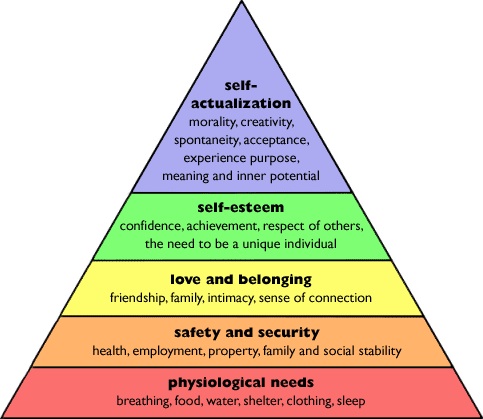
As a psychology major, I understand that we all thrive off of certain basic needs, often derived from Maslow’s hierarchy of needs (shown above). The degree to which we need those things may vary, but basic needs are the same.

There have been events taking place in the area of the state where I went to college that are despicable, and I’m not certain that so many people are as different as we may think. Everyone loves, everyone thrives,  everyone struggles, and everyone fails. Is it really all that necessary to understand the intricacies of what that means for an individual so much so that it robs someone of his or her livelihood?

Love is love. Community is community. So are we all that different, really?

Oh wait. I type with one hand, so maybe this blog post shouldn’t be published. After all, it wasn’t typed with the standard two-handed conventions.

Thursday, May 22, 2014

News I Never Thought I’d Have

source

As someone with a physical disability, it’s a truly momentous personal victory when you realize that something you never thought possible can happen. For me, there are many things that fall into this category, but for now, and as I begin graduate school, one of those things is bike riding. Why? How? What?

Remember the professor who quickly turned to a mentor for me in college? He has been a rider ever since he can remember, and he rode to school on a recumbent bicycle one day. He looked at me and said, “Erin, I think you could do this.” I admittedly thought he was a little crazy, but the idea kept rolling around in my head. Like many through undergraduate degrees, I didn’t really have tike for much of my own hobby, and knowing that I would need some extra attention in terms of the way that it would happen.

Given that I’m off during the summer for the first time in four years this year, I decided that I would  check into the possibility. I researched many, many things and chatted with many experienced cyclists and decided that my need doesn’t lie in an adaptive bicycle, but rather in an adapted bicycle. After about two weeks of Google searching, reading, and studying, I was ready to get serious i the pursuit and found a more-than-ideal engineer that will help me meet my needs. One of the other reasons that considering bike riding was important for me at this point in time is that I sometimes become concerned with how wrapped I am in academic endeavors. While there isn’t anything wrong with that, there’s also something to be said for the need of exercise, an outlet, and well-roundedness.

I’m more than excited to get started,  and be looking for more about the endeavor and adventure in the days, weeks, and months to come. The process will officially begin next week, and I think I’ll use the hashtag #ErinRides on both Facebook and Twitter to track progress, so feel free to add input and follow along!

See you on the trails!

Tuesday, May 13, 2014

Why Research?

source
When I stepped into my first research methods course a little over two years ago, it changed my world. As an academic, I’ve come to realize that many people are confused by a passion for research, but lately, it’s shaping up to be an intense passion. So, what does a beginning researcher glean from conducting empirically based research?

I find that research gives my field purpose. As an undergraduate psychology student, it was hard to imagine myself as anything more than a clinician. After declaring the major, I knew that one either went on to do something completely different in other avenues of education, or you were just that: a psychologist. This course, taught by a young professor who was in his first year of teaching, opened my eyes to the world of empirical research. Throughout the course, we learned everything from the basics of correct source citations and in-text citations to how to propose our own research. The final project entailed our proposing a research project with simulated results. The paper was the most exhilarating one I’d ever written at that time because the work was all my own. The ideas were all my own, and like most of my fellow students, I felt validated and empowered. I finally saw a solid contribution that I could and would make to any field of study. It’s always wise to leave things better than when you found them, and research allows me the opportunity to do exactly that.

Research satiates my hunger to know more. Psychology and related fields are endless contains of knowledge. There isn’t ever  a possibility where someone will know everything there is to know, and that’s almost the most satisfying thing about my hopeful lifetime career in academia. Knowing more also means that the field is able to help people in new, innovative ways that may save a life, a family, hope, joy, love, or any of those things. Because people like myself submit to research journals, we’re contributing to the education of colleagues so that people may enjoy prosperous, productive lives. I always long for that, and research satisfies the longing.

Writing and presentation are two of my favorite academic assignments. Obviously, I’m a blogger, so I enjoy writing, but words are truly beautiful things. I came to appreciate them when I began to read at 4 years of age, and it hasn’t stopped since. Using those words to help advance the field and to help people come to new understandings is simply a joy. In terms of presentation, it thrills me to find ways to interact with others about my research interest, as well as to help them become more educated and involved regarding the topic. During my first conference presentation a little over two years ago, it was most definitely exhilarating. Helping others to find interest by way of my presentation or my writing is thrilling, and by communicating findings, I feel as though I’ve paved the way for additional questions to be formulated.

Many people ask why I am so excited for graduate school, and it’s fairly simple. It’s rooted in research, learning, and teaching.


Tuesday, April 29, 2014

People Are Like Plants

Bear with me for a few minutes here, folks. This is a stretch from graduate school or moving related subject matter, but in an email conversation with a mentor this week that was continued via text message,  I came to realize that people are like plants.

Before I totally lose you. think about it. When you were formed, you were but a tiny morsel, similar to the soil that provides the fertile ground on which you’ll grow and develop. Your root system, your heredity, determines your strength, and to a degree, it determines the way you’ll ultimately see the world and the way that you’ll grow and develop.

In a sense, I’m going through a period of realization in which I must remember my roots.  The flowering branches and the situational evidence for things that have happened in my life have simply colored my experience, all for the better, but remembering my roots is important in this period of stepping out into that field of unknown. When you hear of a plant being re-potted or simply relocated, it must have the exact same  conditions as before, but the fact that the plant is in a new place isn’t changing.

The fact that we need people, we need basic survival materials (food, shelter. clothing, water, etc.), and the fact that we need relationships with said people won’t change no matter where we are. Even though the honeybee sucks the pollen and nectar from the flower at the start, the process will make a beautiful flower, yet again, at the end.  Just as when I begin the great adventure to Kentucky, I’ll need the same things that I needed as a student in Georgia. They’ll be there; I just have to look in different places and become accustomed to the surroundings of Lexington, similar to he process for a plant that has been re-potted.

There’s been an intensely personal struggle with a relationship that everyone needs but that I don’t have for the last several years of my life, and I’ve been the plant with the motto to bloom where I’m planted because the adaptability of my root system speaks volumes. It’s not important to discuss this relationship dynamics, but I a honestly impressed with the resiliency of the human spirit to fill the void with thins that matter, things that can fill the spirit in equal or better ways.

Relocation requires resiliency, and deficit requires compensation, much like in the life cycle of a plant. Bloom where you’re planted,  and good things will blossom.

Wednesday, April 23, 2014

Why Rehabilitation Counseling? My Story

The number one question that I, or anyone who is entering a new phase of education, am asked is about my program of study. And since many are unsure of the field, I thought I’d take some time to delve into the purpose, the motives, and the duties. Equally important is my choice to enter the field, and there is certainly a story there.

When most people hear the words “rehabilitation” and “counseling”, they automatically think about substance abuse and the like. While we will work with clients who have substance abuse difficulties, we will examine and mitigate the effects of the abuse that may be disabling. In addition, it is nearly impossible for a counselor to serve a client who is an active drug user because of his or her inability to be employed.  For example, a client with many years of substance abuse may have memory recall complications. In that instance, depending on the specific circumstance, the client may find that it affects him or her in the workplace or otherwise. A rehabilitation counselor would work to find strategies to help the client to achieve the maximum level of independence and self-sufficiency possible in every aspect of life. For an adult, it may be focused in the workplace, but for a college student, the efforts would be toward success and mitigation of the effects on academic success.

Most often, according to CORE (Council on Rehabilitation Education), an accreditation organization for graduate programs, “[r]ehabilitation [c]ounseling emphasizes empowerment of individuals with disabilities to maximize employability, attain economic self-sufficiency, independence, inclusion, and integration into American society. The philosophical foundation of rehabilitation counseling includes the belief in advocacy and the rights of people with disabilities.  Rehabilitation counseling emphasizes integration and inclusion, focusing on assets of people, and assisting in the pursuit of independence. By moving from a status of dependence to a status of independence, personal adjustment and/or the opportunity to succeed economically, via employment, can be achieved.”

Yet, you still have that question. Why? How?

You see, it started when I was 15 years old. I spent the summer volunteering nearly 50 hours per week at a children’s respite center for children who were determined to be medically fragile.  Ironically enough, most of them shared a diagnostic label with me. And as a just-turned 15 year old, that was hard to see.  I didn’t know, at the time, how to articulate exactly what I was feeling, but I know now that I was grappling with the fact that I honestly didn’t think it was fair that people with the same diagnostic label could perform and such a wide range of levels. Why were these children confined to a wheelchair, but I was the one able to walk? I’d worked brief stints in a self-contained classroom, but giving parents a break seemed like more tangible, meaningful work at that point in my life.

As life progressed and I started having to make decisions, pray over my calling, and devote my life to a purpose, I discovered rehabilitation counseling through a mentor during my junior year of high school. He was the director of disability services during my first three years of college, and he’d gotten his degree at the age of 40 while working full time and raising two children through the online degree program at the University of Kentucky. He does his work with such passion and purpose, and honestly, it was and is infectious.

The fact that my whole career will be spent advocating for and ensuring that people with disabilities are gainfully employed and have means of self-sufficiency just warms my heart. That’s the way it should be. I can’t imagine a place where just because someone looks differently or acts differently, it may affect their chances to enter the workforce. If I put my left leg into my pants first instead of my right, does it mean that I left my house without wearing pants? No. It just means that I did it a bit differently.

Next time you see someone out working in a public place who may accomplish the work task in a non-traditional way, stop and think. Now, you’re also aware of those of us who ensure that everyone is created equal within the workplace.

I ask you: Why NOT rehabilitation counseling?
Friday, March 14, 2014

Where Does Motivation Come From?

During this stage of my life, I'm finding it challenging to retain the sources of motivation that come with going to school full-time and being surrounded by creative, intelligent people with every turn of my head. Fortunately, I'm returning there in August, albeit to a new university, a new setting, and new sights, smells, and sounds.

Most people are shocked when they discover that my motivation does not come from other people with disabilities. I often find solace in understanding that people with disabilities similar to my own have been on the adventure before me, but that's simply a "logistics" meter. Even in 2014, I still have concerns about the accessibility of modern public facilities, as well as the quality of service offered to those with disabilities.

In a recent conversation with a mentor who played football for a legendary coach in college, works for a university to which I have extreme loyalty, and who has a broadcasting background, he simply asked, "Where do you learn? Who motivates you? Is there anybody you study?" Very generally, I answered, "People without disabilities." The reasons for that are many, but the biggest part of my logic centers around the idea that people who are in similar situations are not motivations, simply due to the fact that they may not offer advice that will allow you to better your journey. For example, if two 23 year old young professionals attempted to mentor each other, it would turn into an accountability situation. Since  experience is one of the best teachers we have, the opportunity to learn from experience can come from mentorship.

I'm motivated by the fact that society sees disability as a negative concept. I'm motivated, not because I can prove people wrong with my actions, but because I've always thought of it as the best thing to ever happen to me. Since I've graduated college, the reaction to the simple fact that it happened has been astounding. Honestly, the actions and reactions of people toward me and toward my situation are my biggest source of motivation. Why should I only walk 5 steps when I can walk 10, get more exercise, and have legs like no one has ever seen?

Most recently, I'm motivated by college athletes. Why? College athletes who are successful and who flourish on and off the field of play understand the importance of living a full life, but also the importance of using the platform that a student-athlete offers to be leaders in the community and elsewhere. It doesn't take being a student-athlete to come to these realizations, but the lifestyle allows for an amazing opportunity to see, do, and be many things for the athlete and for others. Wants motivate people far too often, when needs should be driving the bus. A need to give back to the community is not something that is innate in many, but realizing the need can transform sources of motivation. It's an explanation for why my passion for community service is off the charts!

Motivation comes in all shapes and sizes that can vary depending on the current situation and circumstances. Knowing that, why has it become crucial that we fit into a mold that may not fit us? Why do I have to be motivated by people with disabilities just because I happen to have one?

Where does your motivation come from?


Sunday, January 26, 2014

Disability in Graduate School (Or Simply in Life)

I've had plenty of time to do some thinking on the ways that having a disability might actually be advantageous when beginning graduate school this fall. There are rare occasions in which individuals reflect on the positives of something that might challenge the way that they live their lives, but I think it could prove to be an interesting way to learn to appreciate the small things and the unexpected blessings.

Disability is almost always synonymous with "unconventional".  Just because I button a pair of jeans with one hand doesn't mean that my jeans are never buttoned. Though I can't explain to someone how I accomplish it with one hand, I just do. In graduate school, I surmise that many of the research articles that I will read or the papers that I will write will involve complicated intricacies that will drive people to ask, "How do you understand any of what you're studying?" Truthfully, the only way I can and will explain it is that it's what happens when passion is evident. Just like when you realize that you're the only one who can button your pants, it just happens.

One quickly learns that some things just take time. For me, I've had to come to terms with the fact that it's okay if it takes me an hour to get ready to go run errands. The important part is that I accomplished the task independently, and I, most of the time, am confident with the work that I complete. Graduate work isn't conducive to completing the three page paper you forgot about in the two hours before it's due. You can't procrastinate. You can't expect quality if you aren't willing to put in the quantity in the form of time. It's okay that you had to cancel the coffee date with your friend if it means that you're less stressed about the 6 hours it took to put your best effort into the paper. Write the paper, and then reward yourself with the coffee date. You'll feel much better that way because the best things just take time.

The application is just as important as the acquisition. Most of us with disabilities similar in nature to my own spent most of our childhoods in physical and occupational therapies to acquire the skills to live, work, and grow independently. While using stretchy bands to improve quad strength and doing 200 "donkey kicks" while watching television is important, climbing the hills of campus can't become a reality until someone sees that he/she can actually climb the hill or walk the mile distance between a classroom building and the library. Similarly, the textbooks and the coursework are vital in graduate school, but applied experience, such as an internship, truly tests that knowledge. "Thinking on your feet" is challenging, and especially for disciplines like the one I'll be entering, it's just as important to apply effectively as it is to acquire successfully.

You know yourself best, no matter what all the advice in the world says. For years, people with and without disabilities have offered advice on how to do various tasks that have proven challenging. While I often appreciate their advice and concern for me, I have earned to keep in mind that I know my needs and abilities better than anyone. Much like the advice given to new parents, applying to and starting graduate school, as well as living with a disability, opens the proverbial floodgates for all the advice anyone has ever learned. Remember, take what you wish, but you know yourself better than anyone ever will.

Admittedly, there is much more that could be added to this list, but I am enormously grateful for the lessons that life has taught through challenges, and I am eagerly awaiting the chance to apply them to my graduate school experience in 2014!

Wednesday, January 1, 2014

Blogging Every Day: Graduate School, I'm On My Way

Happy New Year, everyone! In years past, I've been one to make many resolutions, but in my current situation, I'm hesitant to do that because so many things could change at any point right now.

Instead, however, I'm planning to blog every day, if even short posts. The reason for setting this goal is three-fold:

I'd like to rekindle my love for writing. I've always loved to write, and through my last little while in college, the only writing that I had time for was my required research papers and class activities. It's not that those exercises weren't enjoyable, but as always, there's something about the freedom of choice that feels...well, free. I am a guest contributor to a few sites around the internet, but there's something to be said for my own personal space to allow myself to let my hair down.

I want to help. My perspective, a soon-to-be graduate student with a little extra challenge, is a rare one to be seen on the internet, so if I can help just one person, it's all worth it. I also want to help myself look back to realize just how fortunate I am when things get a little trying. It's amazing how many people forget to  be thankful, and in 2014, or ever, for that matter, I refuse to be that person. I want to help people realize possibility, peace, faith, joy, and love. If it's just one person, that's simply enough.

I want to keep my skills sharp. More on this later, but it looks like 2014 will bring the start of a graduate program. In graduate school, there's so much writing that it's going to be crucial for me to keep my skills sharp in the interim period. There will be more detail later, for sure, but with the way that the program is set up, it's so important. Most professors have always been complimentary of my writing, but people are different, and it's important to keep every aspect of the skill sharp.

I'm excited to see what 2014 holds, and I am thrilled to have you along for the ride!